
 Amazon & Affiliate Marketing
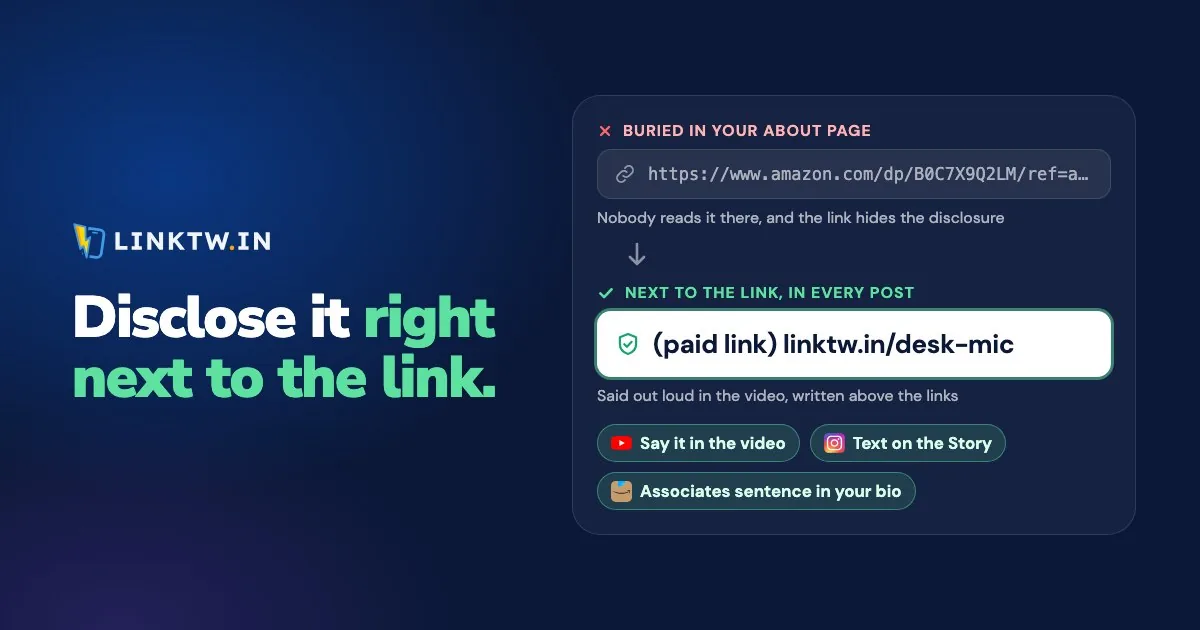
An affiliate disclosure is a short line, right next to your link, that says you earn money when people buy through it: "I earn a commission if you buy through this link", or simply "(paid link)" after the link. The FTC wants it clear, close to the recommendation and in the same form as the post, and Amazon Associates must also show "As an Amazon Associate I earn from qualifying purchases." on their site or social account.
The FTC's own sample line, from its endorsement FAQ, is "I get commissions for purchases made through links in this post." The same page says "paid link" right next to an affiliate link "should be an adequate disclosure of the nature of the link." The rest follows from one idea: the disclosure has to reach the person who sees the link.
- Every post. Someone who missed yesterday's Story hasn't been told.
- Same medium. A spoken recommendation gets a spoken disclosure. On YouTube the FTC wants it in the video and in the description near the links.
- Same language as the post, in a spot people see without looking for it, not mixed into a block of hashtags.
- On the post, not just the profile. Disclosures 101 for Social Media Influencers says a disclosure that sits only on an About Me or profile page is likely to be missed.
Those are US rules, and they can apply to you outside the US: the FTC says US law applies when it's reasonably foreseeable that your videos will be seen by and affect US consumers. The UK and the EU have their own versions, further down.
Affiliate disclosure examples
Adapt these to your voice, and keep the commission in the sentence. "Affiliate link" on its own isn't enough, for reasons the wording table below explains.
Spoken, when the product comes up:
I earn a commission if you buy through the links below.

YouTube description, in the lines that show before "more":
I earn a commission if you buy through these links.
Mic on Amazon (paid link): linktw.in/desk-mic

On a Story, as text next to the link sticker:
Ad: I earn a commission from this link.

On screen and in the first caption line of a Reel or TikTok:
Ad: I earn a commission from the link in my bio.

Instagram bio, channel description or bio page, for Amazon:
As an Amazon Associate I earn from qualifying purchases.
Keep the label next to the link
A disclosure works when it sits with the link, and that's hard to do with a full Amazon URL: two lines of characters push "(paid link)" out of view. A short link like linktw.in/desk-mic fits on the same line as the label and the word Amazon, so people see what the link is, where it goes and that you earn from it before they tap. People tap more when they know what will open, so naming Amazon and the product beside the label is one of the habits that get Amazon affiliate links more clicks.
A LinkTwin bio page puts the disclosure next to your Amazon picks for you. The Amazon block labels each product "Ad" (you can reword the label or show it once above the row), and the page adds "As an Amazon Associate I earn from qualifying purchases." under your products or at the bottom of the page. Both are on by default on any bio page with Amazon products, so the label is beside every button, not on a separate page. Product blocks for other shops have the same label as a switch, and a Text block holds any other disclaimer you need.
Each short link from LinkTwin also does the part that comes after the tap. LinkTwin's Amazon links keep your Associates tag on and open the product in the Amazon app from Instagram, where your follower is already signed in. The label tells people you earn from the tap, and the link makes sure that tap still lands on the product they wanted.
Where to disclose affiliate links
| Post | What people must notice | Where the written line goes |
|---|---|---|
| YouTube video | You say it when the product comes up | Above the links, in the description lines people see before "more" |
| Livestream | You say it, then say it again for people who join late | Above the links in the description |
| Short, Reel or TikTok | Large text on screen, and you say it if you talk about the product | First line of the caption. On TikTok, also the commercial content disclosure toggle |
| Instagram Story with a link sticker | Text on the Story, up long enough to read | On the Story itself. The sticker isn't the disclosure |
| Link-in-bio page | A label next to the affiliate buttons | On the page. Your profile bio doesn't cover those buttons |
| Blog post or newsletter | A line before or beside the first affiliate link | Near the link. A header or footer line alone is easy to miss |
For Stories, Disclosures 101 asks for the text on top of the picture, with enough time to read it. For livestreams, it asks for the disclosure to be repeated so people who watch only part of the stream still get it.
Which disclosure words hold up
The FTC doesn't hand you a required script, but it does reject vague labels, and Amazon and the UK's CMA have lists of their own.
| Line | What the rule-makers say | Use it? |
|---|---|---|
| "I get commissions for purchases made through links in this post." | The FTC's own example | Yes |
| "(paid link)" right after the link | FTC: "should be an adequate disclosure". Amazon lists it too | Yes |
| "Ad:" or "#ad" at the start | FTC: "would likely be effective". UK guidance recommends "ad" or "advert" | Yes, in the US and the UK |
| #CommissionsEarned | One of Amazon's examples of a clear disclosure | Yes, next to the link |
| "affiliate link" on its own | FTC: people might not understand it means you're paid. UK guidance lists #aff and #affiliate as unclear | Only with "I earn a commission" |
| "spon", "collab", or "thanks" or "ambassador" alone | FTC: vague or confusing. UK guidance also lists #spon and #collab as unclear | No |
#sponsored splits the two: the FTC is fine with it alongside a disclosure, while the UK's guidance lists #sponsored as unclear, so leave it out if UK followers see your posts.
Amazon affiliate disclosure is two jobs
Every Associate agreed to section 5 of the Associates Program Operating Agreement:
You must clearly and prominently state the following, or any substantially similar statement previously allowed under this Agreement, on your Site or any other location where Amazon may authorize your display or other use of Program Content: “As an Amazon Associate I earn from qualifying purchases.”
Amazon's help page on identifying yourself as an Associate splits the work in two, and what follows is our reading of it, not legal advice:
- Beside each link. A disclosure that "could be as simple as" (paid link), #ad or #CommissionsEarned, placed near the link where customers will notice it, in the same medium as the recommendation.
- On the account. For social media, the Associate sentence "must be associated with your account", so a bio or channel description is its usual home. A page of Amazon picks gets it on the page too.
Disclosure is one of the Amazon rules a creator meets on every post. The other is the clock: a tap gives you 24 hours for an order, and how the Amazon 24-hour cookie works explains what ends it early.
TikTok, YouTube and Instagram disclosure settings
Each platform has its own switch, and the FTC's advice is to use it on top of your own words: "Don't assume that a platform's disclosure tool is good enough."
TikTok affiliate disclosure
TikTok's Branded Content Policy counts "a product or service for which you will receive a commission on any sales (for instance, via an affiliate link or promotional code)" as branded content, and says you must enable the commercial content disclosure toggle when you post it. Turn it on, then still say it and show it on screen, because a caption is easy to miss.
Affiliate link disclosure on YouTube
YouTube's paid promotion setting, under Show more when you upload in YouTube Studio, adds a disclosure label at the start of the video. It's written for brand deals, the kind landing your first YouTube sponsor is about, and the help page doesn't mention affiliate links. Whether you tick it or not, the commission still needs to be said in the video and written near the links.
How to disclose affiliate links on Instagram
Instagram's branded content page for creators says that if you're "getting paid in any form" for your content, you add a Paid Partnership label. The page doesn't spell out affiliate commissions, so treat the label as an extra and keep "Ad" or "(paid link)" in the Story text or the caption's first line.
UK and EU affiliate disclosure
- United Kingdom. The CMA's guidance for content creators lists "affiliated links or programmes" among content to label as an ad, recommends "ad" or "advert", and warns that hidden ads can mean "a substantial fine".
- European Union. The European Commission's Influencer Legal Hub says EU consumer law already requires advertising, including affiliate marketing, to be disclosed.
- Anywhere else. Check your country's consumer protection or advertising authority.
For an audience in both the US and the UK, starting with "Ad", as in "Ad: I earn a commission from my Amazon links", covers both lists.
Common questions
I paid for the product myself. Do I still disclose?
Yes, when the link pays you. What you disclose is the commission you earn on other people's purchases, and that's there whoever paid for your own copy of the item.
Do I need a disclosure in a DM?
Yes, in the message, near the link. "(paid link)" after it is one of Amazon's own examples. Amazon allows its links in direct messages only when the person asked for them, so this is for people who replied or requested the link, not a cold send.